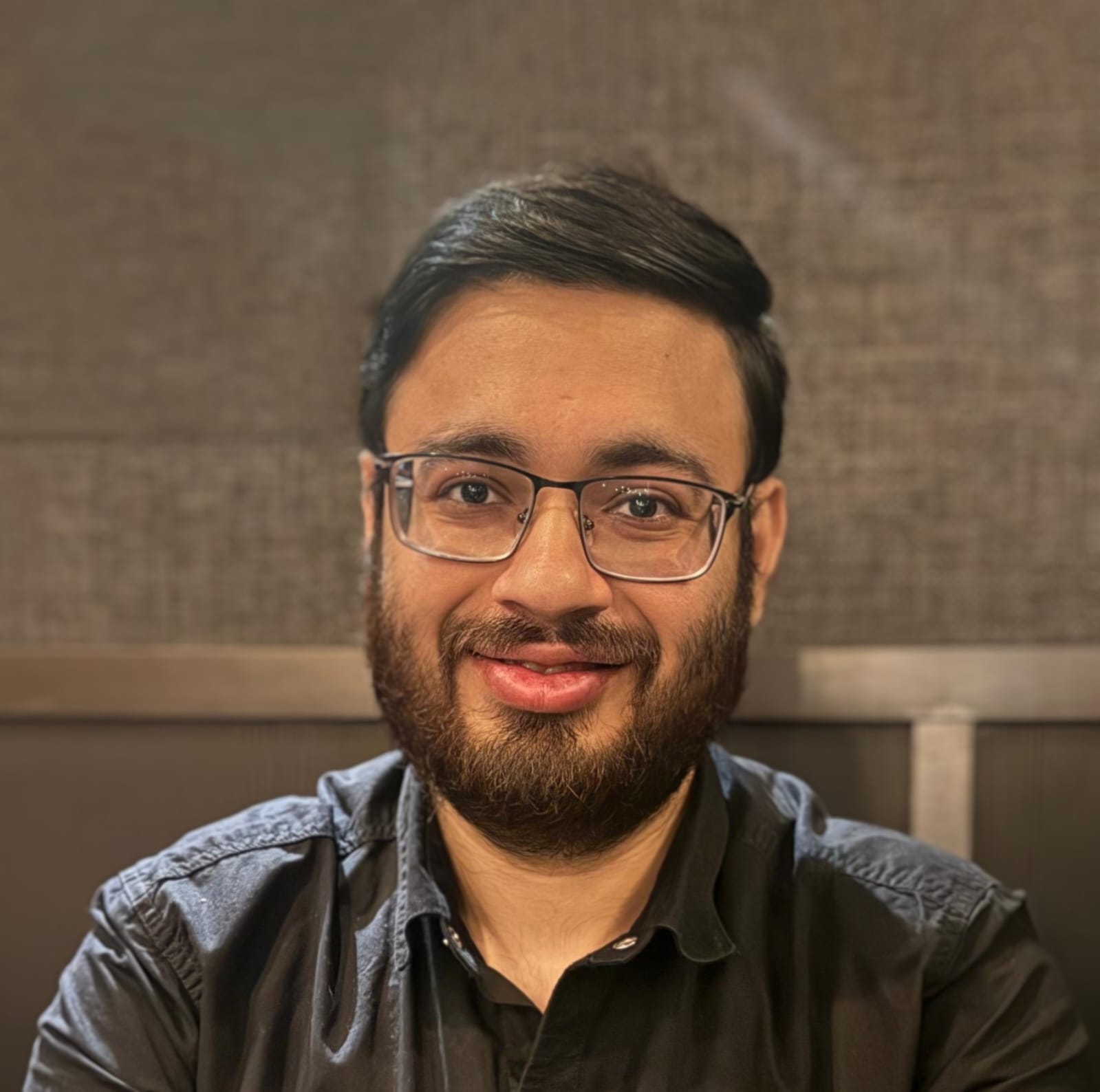
Vishal Asnani / Research Scientist
Building trust
in this AI-generated era.
I’m a Research Scientist at Adobe Research in San Jose. I work on video and audio watermarking, image provenance, and generative AI attribution: methods that help answer where content came from, what influenced its creation, and whether it has been manipulated. My research connects content authenticity and responsible AI with practical safeguards for digital media, including durable Content Credentials for video.
I earned my Ph.D. in Computer Science and Engineering at Michigan State University in December 2024, advised by Prof. Xiaoming Liu. Before joining Adobe full-time in January 2025, I interned at Adobe in 2023 and 2024, collaborating with John Collomosse and Shruti Agarwal.
Publications · CV · Talks & tutorials · Get in touch
Recent news
-
Signpost Watermarking, our work on joint optimization for visual watermark coexistence, was accepted to the ECCV 2026 LifegenIP Workshop.
-
FlowMark, our work on mask-guided video watermarking, is available as a preprint.
-
Co-organized Foundations and Frontiers of Watermarking at CVPR 2026, covering methods, multimodal extensions, robustness, and authenticity frameworks.
Our deepfake benchmark audit is available as a preprint.
TokenTrace and our edit-friendly hard prompt inversion work appeared at CVPR; PiVoT appeared at CVPR Workshops.
-
Our survey of proactive schemes appeared in the April issue of IJCV.
-
NRGMark appeared at WACV 2026, exploring localized watermarking for energy transparency in images.
-
Your Text Encoder Can Be An Object-Level Watermarking Controller appeared at ICCV, and CustomMark appeared at the ICCV APAI Workshop.
-
Joined Adobe Research as a Research Scientist.
-
Completed my Ph.D. at Michigan State University.
Our work on hyperparameter dependencies for model parsing appeared at NeurIPS 2024.
-
Shared the first version of our survey of proactive schemes, bringing together applications of purposeful signals in computer vision. The survey is now published in IJCV.
-
ProMark appeared at CVPR 2024, introducing proactive diffusion watermarking for causal attribution.
-
Returned to Adobe Research as a Research Scientist Intern, continuing research on generative AI attribution.
-
Shared the news that ProMark was accepted to CVPR 2024, following research during my 2023 Adobe internship.
-
Our Reverse Engineering of Deceptions survey was published in Foundations and Trends in Privacy and Security.
-
Our reverse engineering of generative models paper appeared in the December issue of TPAMI, exploring how generated images reveal model hyperparameters.
-
PrObeD, our proactive wrapper for object detection, was accepted to NeurIPS 2023.
-
Our work on reverse engineering generative models and inferring their hyperparameters was accepted to TPAMI.
-
MaLP, our proactive approach to manipulation localization, appeared at CVPR 2023.
Co-organized the Reverse Engineering of Deceptions tutorial at CVPR 2023.
-
Joined Adobe Research as a Research Scientist Intern, collaborating with John Collomosse and Shruti Agarwal on proactive attribution for generative AI.
-
Shared the news that MaLP: Manipulation Localization Using a Proactive Scheme was accepted to CVPR 2023.
-
Gave an in-person talk at Scale AI on reverse engineering generative models.
-
Gave a virtual talk at Scale AI on proactive image manipulation detection.
-
Proactive Image Manipulation Detection appeared at CVPR 2022, exploring learnable templates for detecting manipulated images.
-
Proactive Image Manipulation Detection was accepted to CVPR 2022.
Research areas
Content authenticity
Signals that help media tell its story.
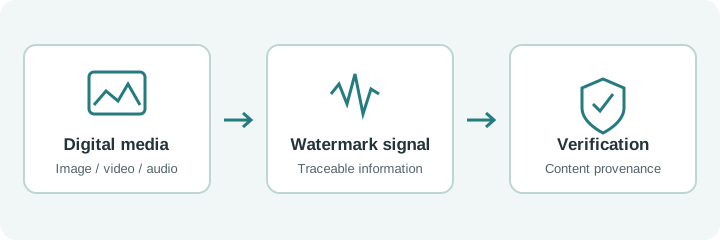
Video and audio watermarking, localized image metadata, and visual watermark coexistence for traceable media.
Generative AI attribution
Tracing the ideas behind the image.
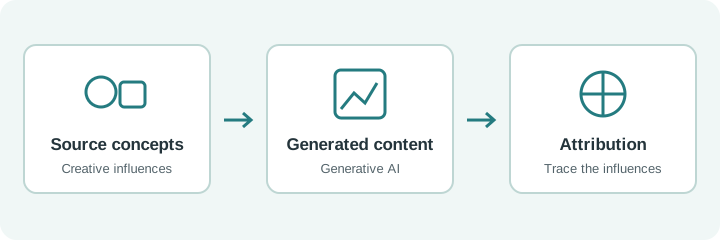
Tracing creative influences through watermarked training data, diffusion-model customization, and token recovery.
Media forensics & evaluation
Looking beyond what meets the eye.
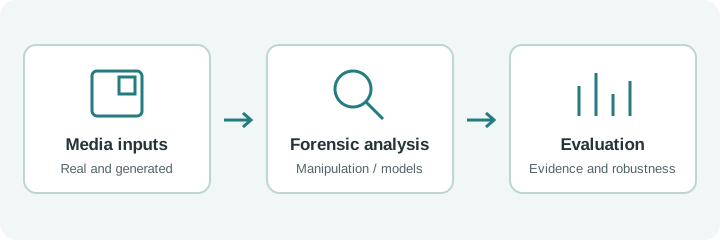
Localizing manipulation, inferring model properties, and testing what deepfake benchmarks really measure.
Illustrative research-area overviews, not experimental results.
Selected publications
Four perspectives on trustworthy media: watermarking video, tracing creative influences, localizing manipulation, and reverse engineering generative models.
FlowMark
FlowMark: Mask-Guided Video Watermarking
- The problem
- How can we add provenance signals to video, not just individual images?
- Our approach
- Explore mask-guided watermarking for video.
- Why it matters
- Extends the study of content provenance to moving imagery.
TokenTrace
TokenTrace: Multi-Concept Attribution through Watermarked Token Recovery
- The problem
- A generated image can combine several concepts. Which ones influenced it?
- Our approach
- Recover watermarked tokens to attribute generated images to multiple concepts.
- Why it matters
- Makes the mix of influences in generated content more traceable.
MaLP
MaLP: Manipulation Localization Using a Proactive Scheme
- The problem
- Knowing an image was manipulated is not enough. Where was it changed?
- Our approach
- Use a proactive template and local-global features to localize image manipulation.
- Why it matters
- Moves beyond a real-or-fake label to identifying manipulated regions.
Reverse engineering
Reverse Engineering of Generative Models: Inferring Model Hyperparameters from Generated Images
- The problem
- What can generated images reveal about the model that created them?
- Our approach
- Infer generative-model architecture and loss-function attributes from generated images.
- Why it matters
- Investigates the origins of synthetic media beyond detecting that it is generated.
Community and collaboration
I mentor research interns, co-organize tutorials, and review for venues including CVPR, ICCV, ECCV, TPAMI, IJCV, ICLR, AAAI, ACM Multimedia, and WACV. I also co-organized the CVPR 2023 tutorial Reverse Engineering of Deceptions and presented my research at Scale AI.
I welcome collaborations on watermarking, content authenticity, responsible AI, media provenance, and deepfake detection. Reach me at vishal.8.asnani@gmail.com.
My collaborators have included Xiaoming Liu, Tal Hassner, John Collomosse, Shruti Agarwal, Xi Yin, and Sijia Liu.
Selected media coverage
Our research on reverse engineering generative models was covered by CNBC, The Verge, VentureBeat, The Wall Street Journal, and MSU Today.
Outside research
I enjoy long drives, jigsaw puzzles, reading, football, badminton, and table tennis.