
Research / 2024
ProMark: Proactive Diffusion Watermarking for Causal Attribution
Published in IEEE/CVF Conference on Computer Vision and Pattern Recognition, 2024
Overview
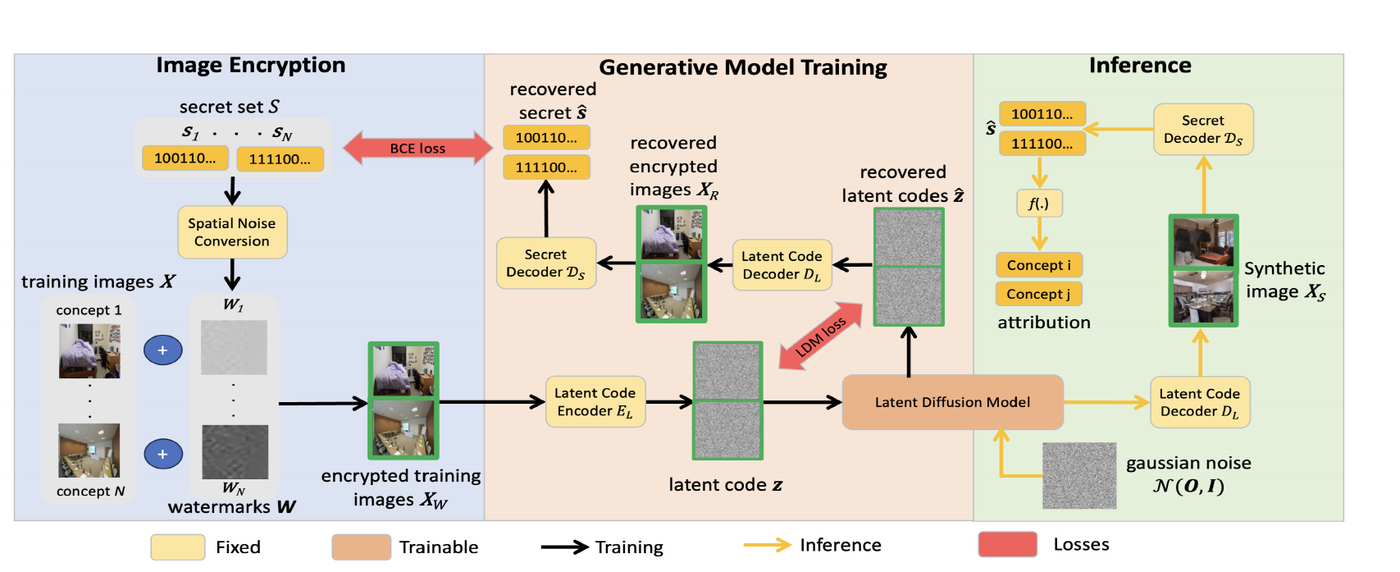
Visual resemblance alone does not establish which training concepts influenced a generated image. ProMark introduces concept-specific watermark signals during training and retrieves those signals from generated content.
How it works
- Encode source concepts, such as content categories or artistic media, as bit secrets.
- Watermark the corresponding training images and train the diffusion model to retain those signals.
- Decode generated images to attribute one or more concepts rather than relying only on nearest-image similarity.
A reported result
84.66% combined media-and-content attribution accuracy on BAM, using two watermarks per image at 30% watermark strength, Table 3.
That is joint attribution of both concepts, not bit accuracy. Table 3 reports 46.23% for the AbC-CLIP comparison. ProMark’s 16-bit identifier space supports 2^16 (65,536) distinct watermarks; capacity is not a promise of perfect recovery at that scale.
Scope
The approach assumes access to the training or fine-tuning process and watermarked source data. Stronger watermarks can improve recovery while introducing visible artifacts, so attribution and image quality must be assessed together.
Sources and resources
See Sections 4.2-4.3, Table 3, and Figure 5.
Bibliographic reference
Asnani, V., Collomosse, J., Bui, T., Liu, X., Agarwal, S. (2024). ProMark: Proactive Diffusion Watermarking for Causal Attribution. In Proceedings of the IEEE/CVF Conference on Computer Vision and Pattern Recognition.