
Research / 2026
Proactive Schemes: A Survey of Adversarial Attacks for Social Good
Published in International Journal of Computer Vision (IJCV), 134(4), 2026
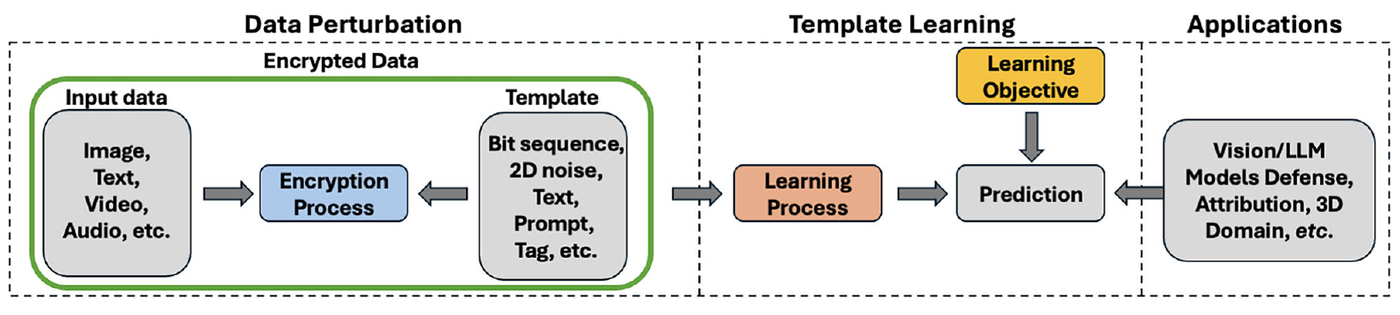
Overview
The same tools used to construct adversarial perturbations can also support protective and constructive uses. This survey organizes proactive schemes that deliberately modify inputs to help a downstream task.
What it covers
- Template representations, including bit sequences, two-dimensional signals, text, and prompts.
- How a template is embedded into the input and optimized against task-specific objectives.
- Applications in media forensics, attribution, privacy, ownership verification, and vision and language-model defense.
A research takeaway
A proactive scheme is a complete pipeline, not simply added noise. Template design, the perturbation operation, the learning process, and the downstream objective must be considered together.
The framework in Figure 2 connects these design choices and distinguishes proactive input modification from passive processing of an unchanged input.
Scope
This is a literature survey, so it does not introduce one benchmark score that represents every application. Beneficial intent does not remove questions about robustness, transferability, vulnerability, or practical deployment; these remain part of the survey’s discussion.
The figure and overview use the published IJCV version, rather than the earlier review manuscript.
Source
Bibliographic reference
Asnani, V., Yin, X., Liu, X. (2026). Proactive Schemes: A Survey of Adversarial Attacks for Social Good. International Journal of Computer Vision, 134(4).