
Research / 2023
MaLP: Manipulation Localization Using a Proactive Scheme
Published in IEEE/CVF Conference on Computer Vision and Pattern Recognition, 2023
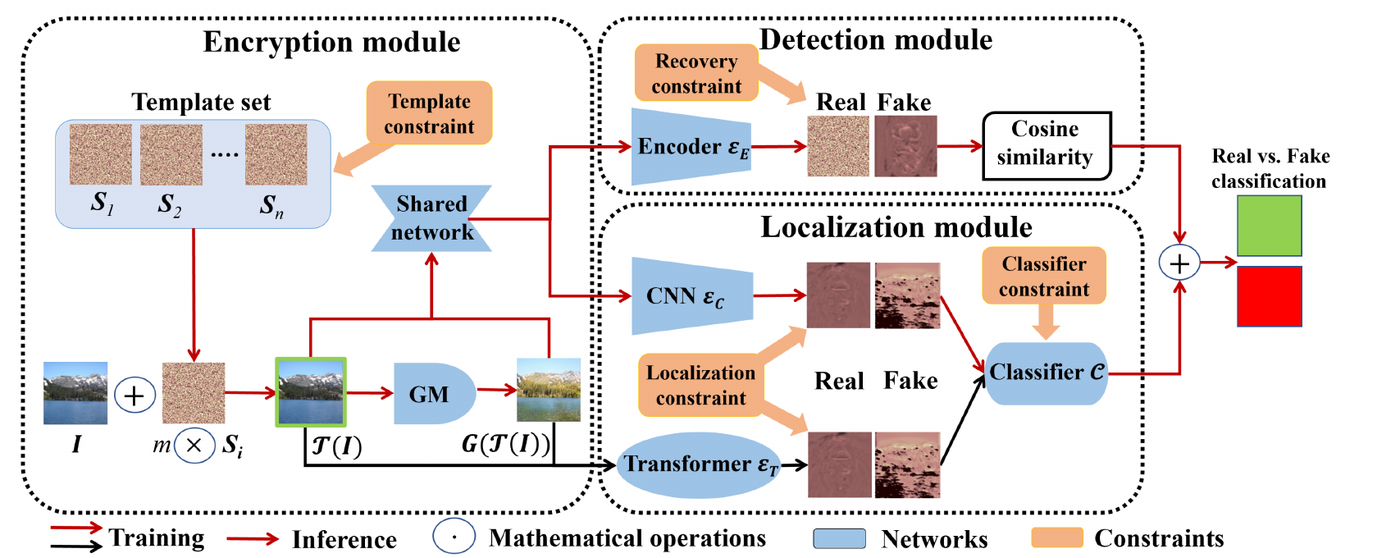
Overview
Knowing an image is fake does not tell us where it changed. MaLP adds a learned template before manipulation and uses that signal to estimate a pixel-level fakeness map.
How it works
- An encryption module adds a template to the original image.
- CNN and transformer branches learn local and global features during training.
- At inference, the shallow CNN branch provides localization without running the transformer. A detection module also supports real-versus-fake classification.
A reported result
0.9394 cosine similarity for localization in the paper’s CelebA/STGAN comparison in Table 2, versus 0.8831 for the stronger comparison method in that table.
This is a localization metric, not detection accuracy. The same comparison reports an SSIM trade-off: 0.7312 for MaLP versus 0.7876 for that baseline. Generalization is examined separately across 22 unseen generative models.
Scope
The approach requires template protection before manipulation. It does not assume that arbitrary, previously unprotected images already contain the required signal.
Sources and resources
Bibliographic reference
Asnani, V., Yin, X., Hassner, T., & Liu, X. (2023). MaLP: Manipulation Localization Using a Proactive Scheme. In Proceedings of the IEEE/CVF Conference on Computer Vision and Pattern Recognition.