
Research / 2022
Proactive Image Manipulation Detection
Published in IEEE/CVF Conference on Computer Vision and Pattern Recognition, 2022
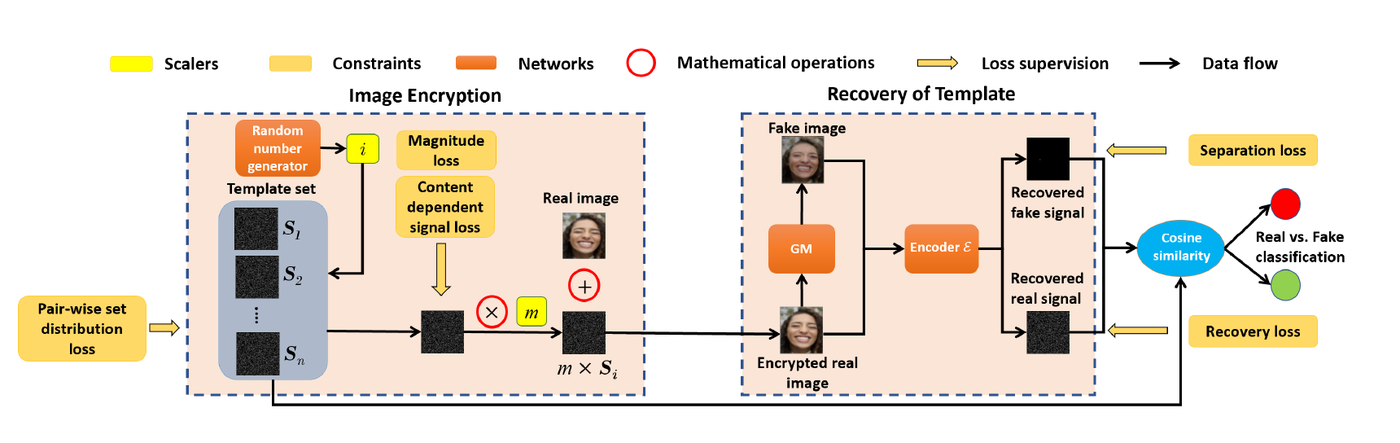
Overview
Can images be prepared to make future manipulation easier to detect? This work moves part of the forensic process before the edit: a learned template is added to an original image, giving the detector a signal to examine later.
How it works
- Learn a set of low-magnitude, high-frequency templates with constraints on diversity and recoverability.
- Protect an image with a selected template before it reaches a manipulation model.
- Recover the signal from protected or manipulated images and use it for classification.
A reported result
92.43% mean average precision across 12 unseen generative models, versus 82.97% for the Wang et al. baseline in Table 4.
The proactive model is trained using STGAN in this comparison. The number is an average of per-model average precision, not classification accuracy or a guarantee at a particular false-alarm rate.
Scope
Protection must be applied before manipulation. This is not a passive detector for arbitrary unprotected images, and performance varies by manipulation model.
Sources and resources
The numerical comparison is from Section 4 and Table 4.
Bibliographic reference
Asnani, V., Yin, X., Hassner, T., Liu, S., & Liu, X. (2022). Proactive Image Manipulation Detection. In Proceedings of the IEEE/CVF Conference on Computer Vision and Pattern Recognition.