
Research / 2024
Reverse Engineering of Deceptions on Machine- and Human-Centric Attacks
Published in Foundations and Trends in Privacy and Security, 2024
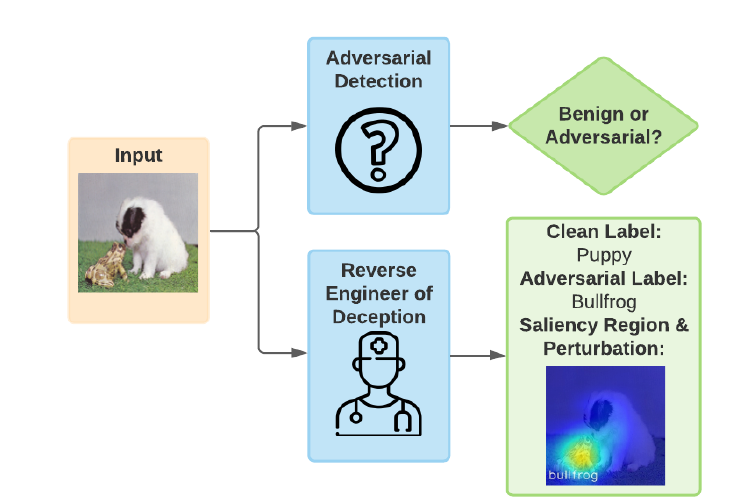
Overview
Detecting deception is only one part of understanding it. This tutorial monograph connects attacks on machine-learning systems with synthetic media intended to mislead people, asking what their outputs reveal about the underlying toolchain.
What it covers
- Machine-centric attacks: recovering perturbation evidence, saliency information, and victim-model attributes from adversarial examples.
- Human-centric attacks: inferring generative-model properties and localizing manipulated image regions.
- Technical formulations, example pipelines, experiments, and open challenges across those distinct problems.
A research takeaway
Detection, localization, and model parsing answer different questions. A real-or-fake decision does not by itself identify the altered region or explain the generator and attack process.
The published Introduction and chapter organization provide this framing. The figure illustrates the adversarial-example chapter, not one unified method for every deception type.
Scope and source version
This is a survey/tutorial spanning multiple methods, not a single detector with one meaningful headline accuracy. The figure comes from the authors’ full manuscript, not the publisher-typeset version. The reading link points to the official published monograph.
Source
Bibliographic reference
Yao, Y., Guo, X., Asnani, V., Gong, Y., Liu, J., Lin, X., ... & Liu, S. (2024). Reverse Engineering of Deceptions on Machine-and Human-Centric Attacks. Foundations and Trends® in Privacy and Security, 6(2), 53-152.