
Research / 2026
TokenTrace: Multi-Concept Attribution through Watermarked Token Recovery
Published in IEEE/CVF Conference on Computer Vision and Pattern Recognition (CVPR), 2026
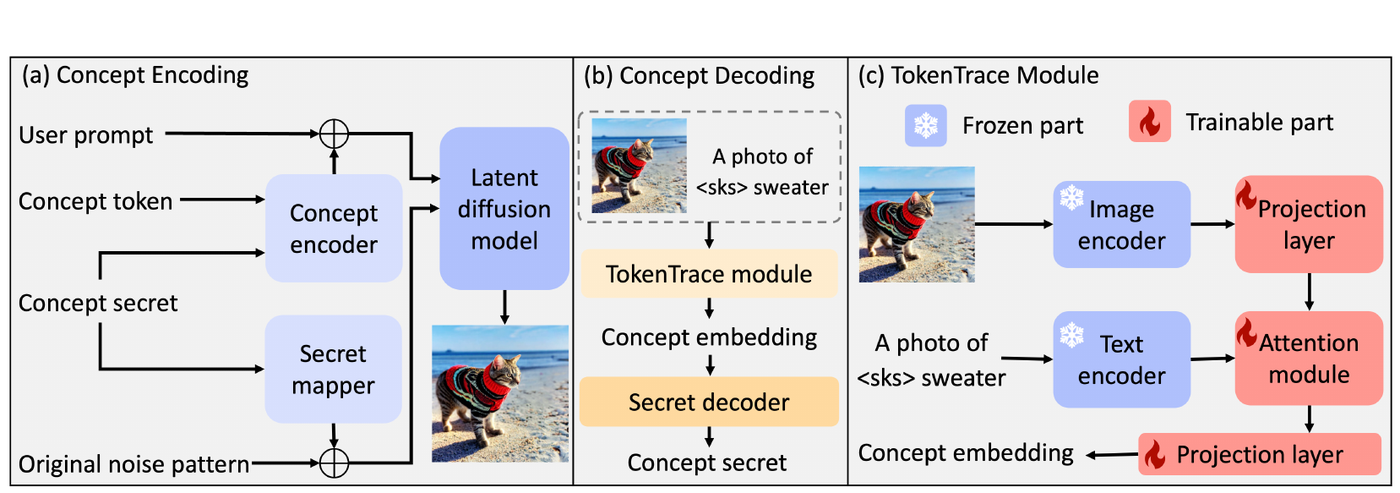
Overview
One generated image can contain several creative influences. TokenTrace asks how to verify each influence separately, rather than treating the entire image as one attribution target.
How it works
- Concept secrets perturb both the relevant text-token embedding and the initial latent noise used for generation.
- At verification time, the generated image and a textual query identify the concept to retrieve.
- Frozen image and text encoders work with trainable projection and attention layers to recover a concept embedding and decode its secret.
A reported result
88.62% attribution accuracy, compared with 85.14% for CustomMark, for the two-customized-concept setting in Table 2.
That setting combines an object and a style from a pool of 20 customized concepts. The paper uses Stable Diffusion 1.5 and a default 16-bit secret. Attribution accuracy measures exact secret recovery, not the fraction of individual bits recovered.
The result above refers to the base TokenTrace method. The prompt-weighted variant, TokenTraceP, is reported separately; its higher numbers are not substituted here.
Scope
This is proactive attribution: secrets must be embedded through the generation pipeline. It is not a post-hoc ownership test for arbitrary images generated without those signals.
Source
Bibliographic reference
Li Zhang, Shruti Agarwal, John Collomosse, Pengtao Xie, Vishal Asnani. (2026). TokenTrace: Multi-Concept Attribution through Watermarked Token Recovery.