
Research / 2026
Signpost Watermarking: Joint Optimization for Visual Watermark Coexistence
Accepted to ECCV 2026 LifegenIP Workshop
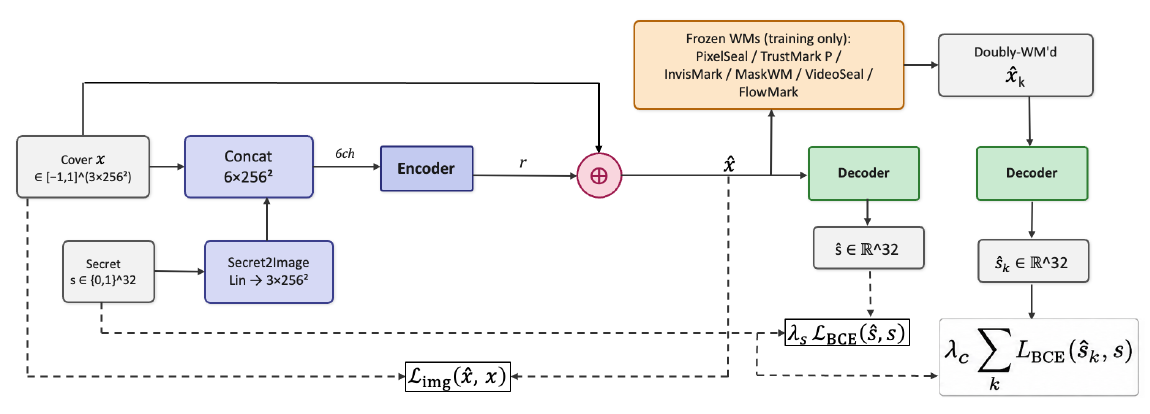
Overview
How can one watermark help discover another without disrupting it? Signpost watermarking investigates a lightweight routing signal that indicates which independently deployed provenance watermark should be decoded.
How it works
- A U-Net encoder adds a residual carrying a 32-bit secret; a ResNet-50 decoder recovers it.
- Frozen secondary watermark systems are applied during training.
- Decoder-aware objectives optimize coexistence in both image and video settings, rather than assuming independently trained signals will not interfere.
A reported result
0.988 bit accuracy for TrustMark-P when the signpost is added on top, in the clean image-coexistence setting, Table 2.
The table reports a 0.008 decrease relative to TrustMark-P alone. This measures recovery of the first watermark, not the signpost’s own accuracy, and does not describe performance after every distortion.
Scope and source version
Coexistence remains pairing- and order-dependent. The manuscript includes cases with greater interference, so this is not universal interoperability.
Accepted to the ECCV 2026 LifegenIP Workshop. The figure and results use the August 2026 public manuscript, version 1; an official workshop proceedings link has not yet been verified.
Bibliographic reference
Shruti Agarwal, Vishal Asnani, John Collomosse. (2026). Signpost Watermarking: Joint Optimization for Visual Watermark Coexistence. Accepted to the ECCV 2026 LifegenIP Workshop.