
Research / 2026
PiVoT: Proactive Video Templates for Enhancing Video Task Performance
Published in IEEE/CVF Conference on Computer Vision and Pattern Recognition Workshops (CVPR Workshops), 2026
Overview
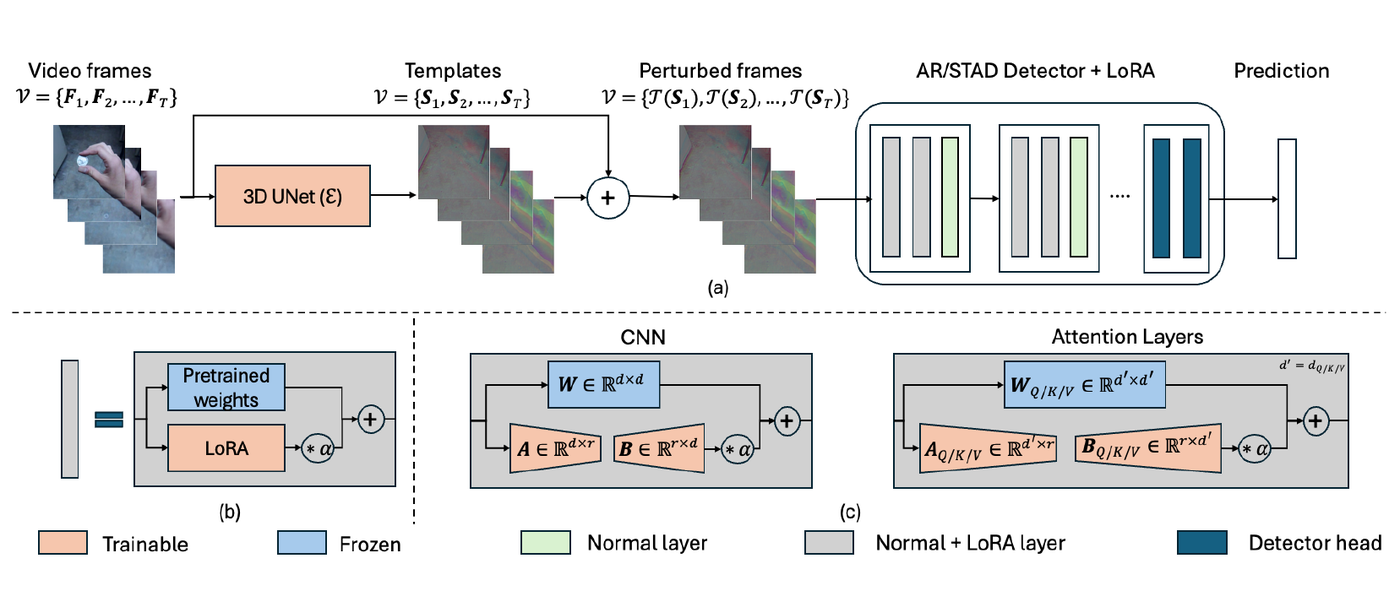
Can a learned change to video frames make motion easier for a model to understand? PiVoT extends proactive templates to video, pairing temporal input adaptation with parameter-efficient model adaptation.
How it works
- A 3D U-Net creates frame-specific templates that capture temporal information.
- The templates alter the video frames supplied to the downstream model.
- The pretrained backbone stays frozen while the template generator and rank-4 LoRA adapters are trained.
Experiments cover action recognition on Kinetics-400 and Something-Something-v2, and spatiotemporal action detection on AVA2.1.
A reported result
27.12% mAP with PiVoT versus 24.11% for the reproduced SlowFast baseline on AVA2.1, Table 3.
This is action-detection mAP, not recognition Top-1 accuracy. The comparison uses the paper’s reproduced baseline rather than substituting the original reported score.
Scope
PiVoT adds template-generation and adapter computation. Its templates are not constrained to be imperceptible, so performance improvement should not be read as a claim of visually unchanged input video.
Source
Bibliographic reference
Vishal Asnani, Shruti Agarwal, Xiaoming Liu. (2026). PiVoT: Proactive Video Templates for Enhancing Video Task Performance.