
Research / 2026
NRGMark: Localized Watermarking for Energy Transparency in Images
Published in IEEE/CVF Winter Conference on Applications of Computer Vision (WACV), 2026
Overview
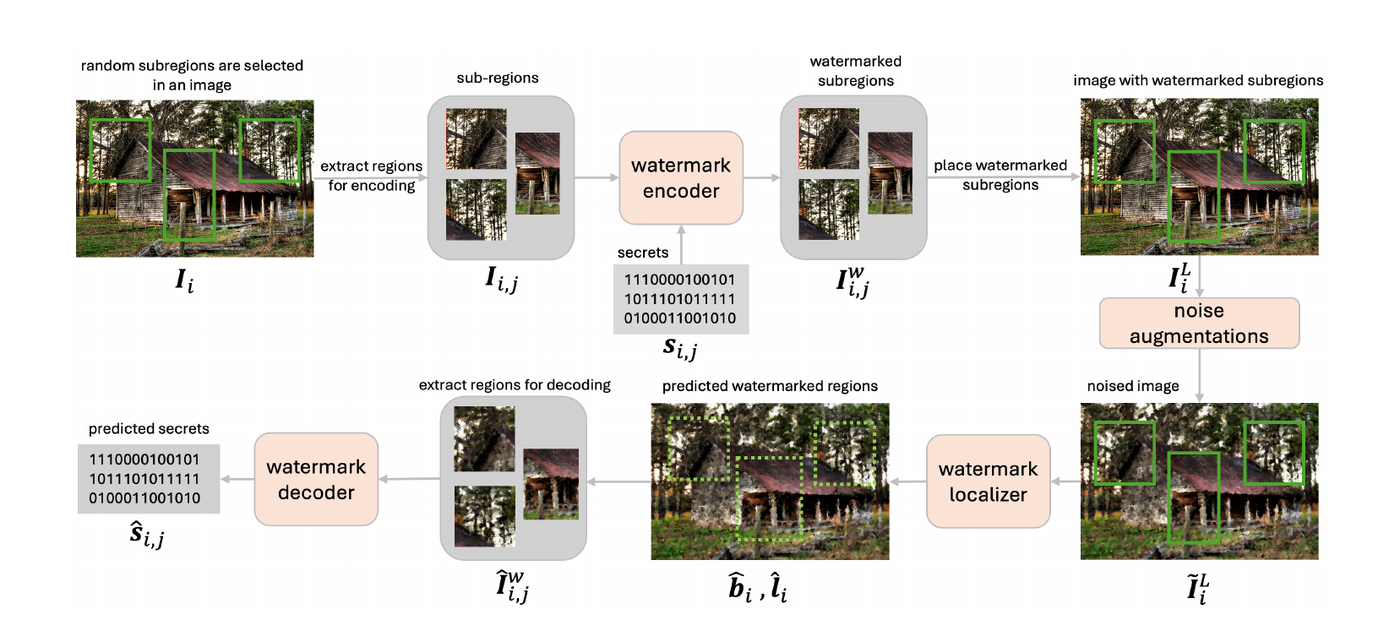
A composite design can contain several images with different origins and energy footprints. NRGMark gives individual visual elements independent identifiers rather than assigning one provenance payload to the whole design.
How it works
- Watermark selected image regions with separate bit secrets.
- Train a localizer to find those regions after compositing and image transformations.
- Decode the localized regions and use their identifiers to look up provenance and environmental-impact records through a C2PA extension.
The framework is tested with five watermark encoder-decoder systems, as well as design-layout and print-scan examples.
A reported result
0.94 localization IoU for NRGMark with TrustMark-P on noisy MIRFlickR images, compared with 0.95 without noise, Table 1.
IoU measures agreement between predicted and target regions. It is distinct from message bit accuracy, which the paper examines separately in Figure 5.
Scope
NRGMark links pixels to an external record; it does not estimate energy consumption from an image or independently validate every value in that record. Recovery depends on the watermark, region size, and distortions.
The result above is from Table 1.
Bibliographic reference
Shruti Agarwal, Elie Michel, Vishal Asnani, Tania Mathern, John Collomosse. (2026). NRGMark: Localized Watermarking for Energy Transparency in Images.