
Research / 2026
FlowMark: Mask-Guided Video Watermarking
Preprint, 2026
Overview
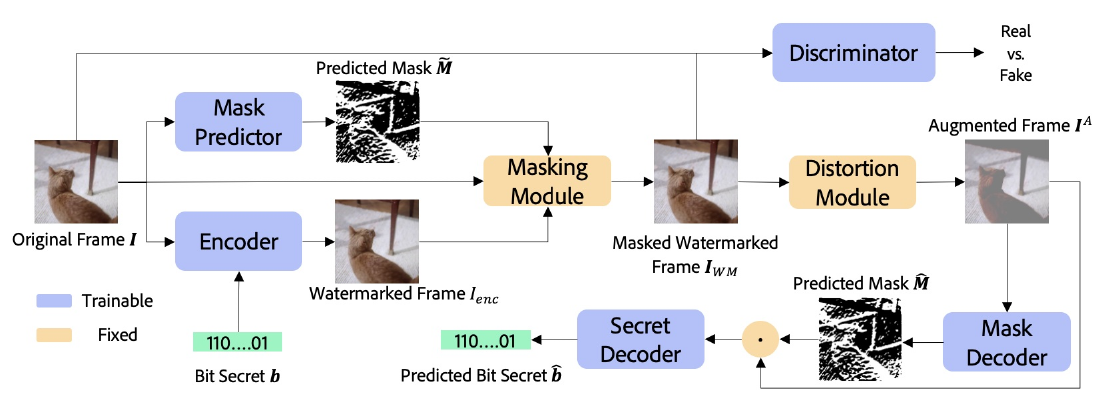
Where should a watermark go in a video frame? FlowMark learns content-adaptive embedding regions rather than relying on manually supplied or random masks. The goal is to preserve visual quality and temporal consistency while keeping provenance signals recoverable.
How it works
- A mask predictor identifies suitable regions; a message-conditioned encoder embeds the watermark.
- Perceptual modulation and a temporal-consistency objective help limit visible distortion and flicker.
- Training progressively introduces image distortions and video codecs. Separate decoder branches recover the embedding mask and message.
A reported result
50.41 dB PSNR with a 128-bit payload in the clean, no-augmentation SA-V evaluation in Table 1. Reported bit accuracy is 1.00 in that setting.
The paper evaluates on the SA-V test set of 155 videos at 24 fps. These clean-setting numbers should not be read as perfect recovery after every edit: Table 2 reports 0.80 bit accuracy under combined video distortions.
Scope
This is a preprint, not a peer-reviewed proceedings paper. Its results cover the datasets, codecs, and editing conditions tested; they are not a guarantee for every distribution pipeline.
Source
Bibliographic reference
Vishal Asnani, Shruti Agarwal, John Collomosse. (2026). FlowMark: Mask-Guided Video Watermarking. arXiv:2607.05261.