
Research / 2026
Interpretable Prompts made Edit-Friendly: Token-to-Token Similarity Reduction in dLLMs for Edit-Friendly Hard Prompt Inversion
Published in IEEE/CVF Conference on Computer Vision and Pattern Recognition (CVPR), 2026
Overview
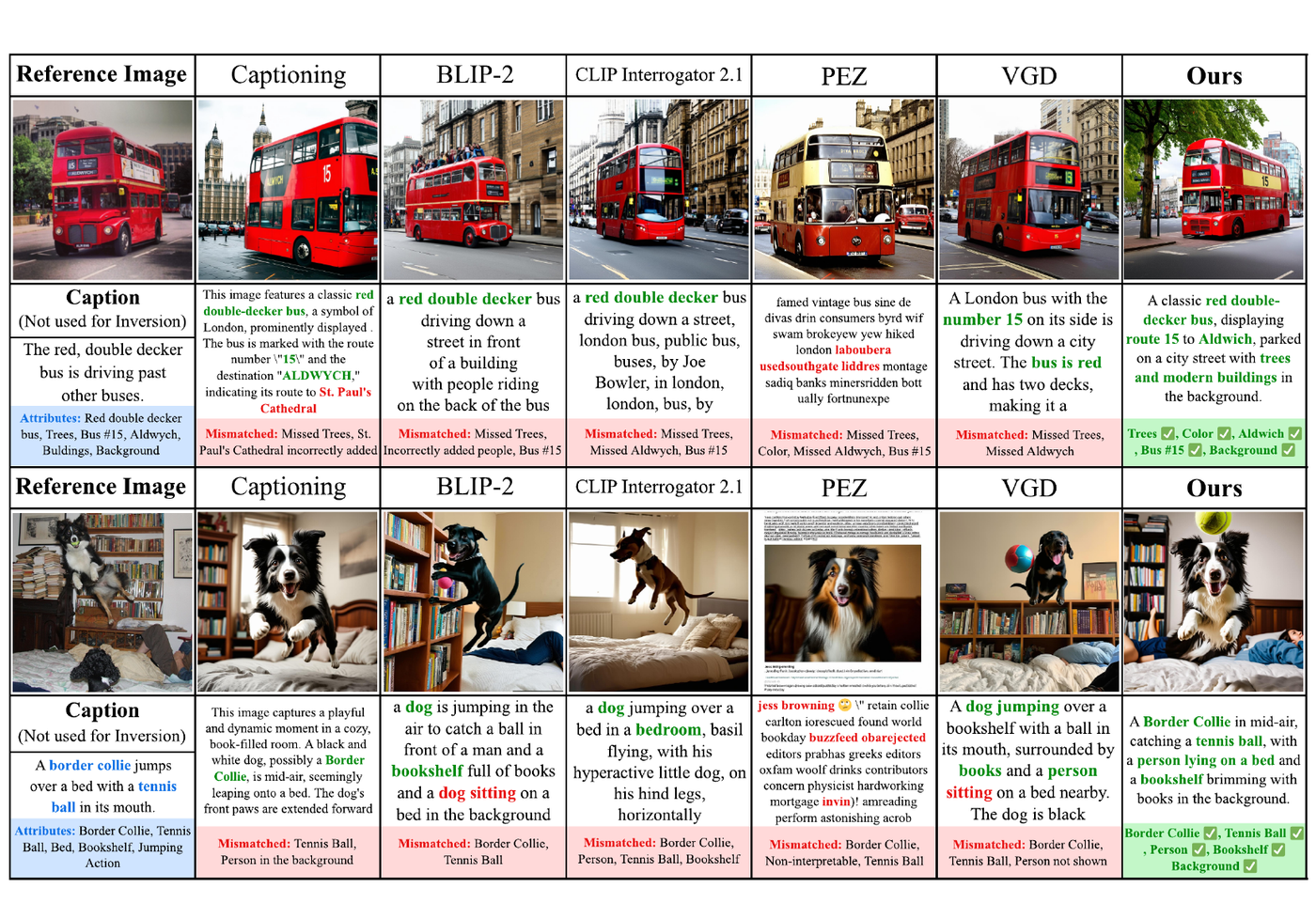
An image-reconstruction prompt is more useful if a person can understand and edit it. This work inverts reference images into discrete prompts designed for later word substitutions and additions.
How it works
- A discrete diffusion language model refines prompt tokens in parallel.
- Image alignment guides the prompt toward the reference image.
- Token-similarity steering reduces coupling between token positions, aiming to make localized concept edits more reliable.
Neither the text-to-image model nor the language model requires fine-tuning.
A reported result
10.50 seconds versus 104.20 seconds for VGD at a 77-token budget on one A6000 GPU, Table 2.
In that comparison, CLIP-image similarity is 0.74 versus 0.68. These are inversion timings, not the total time for an arbitrary editing workflow. Faster captioning methods are also reported but have different reconstruction scores.
Scope
Reconstruction similarity, readable text, and editability are different objectives. The paper evaluates token swaps and appends separately with semantic metrics and user studies; an editable prompt is not a pixel-exact inverse of an image.
Source
Bibliographic reference
Naresh Kumar Devulapally, Shruti Agarwal, Vishal Asnani, Vishnu Suresh Lokhande. (2026). Interpretable Prompts made Edit-Friendly: Token-to-Token Similarity Reduction in dLLMs for Edit-Friendly Hard Prompt Inversion.