
Research / 2018
Dual Band Microstrip Patch Antenna with Secondary Patch
Published in IEEE International Conference on Communication and Signal Processing (ICCSP), 2018
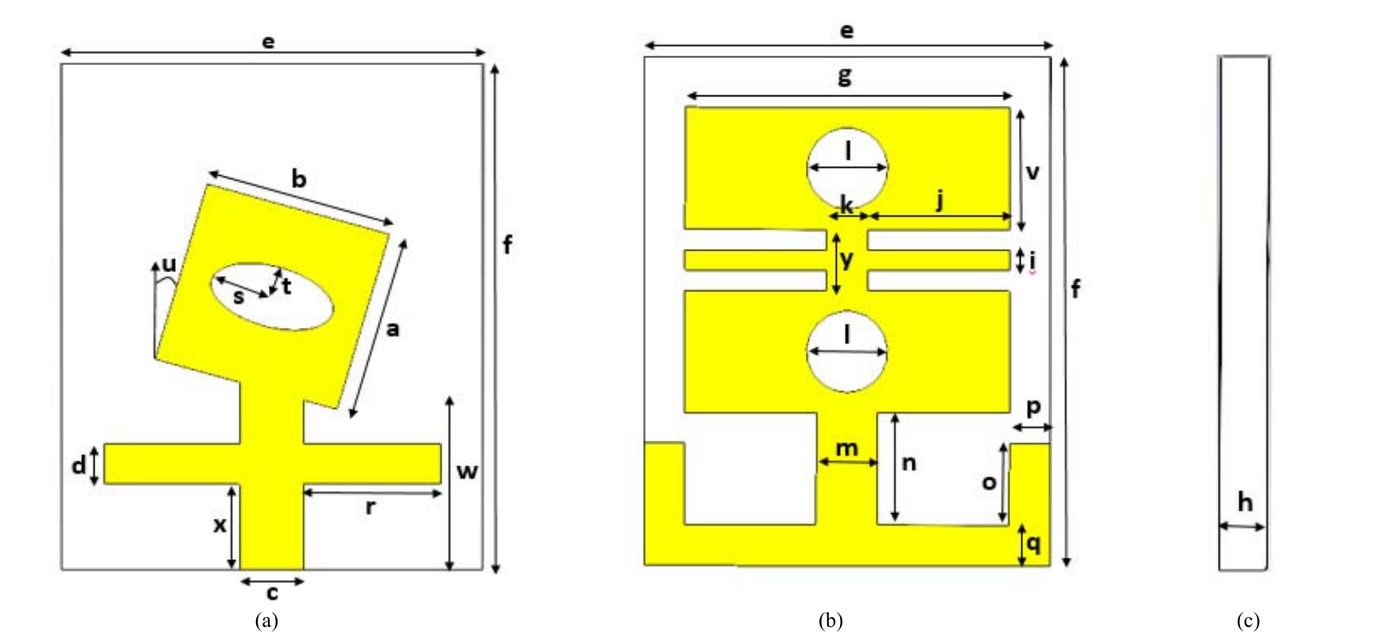
Overview
Can a compact printed antenna support two separated operating bands? This earlier research studies how patch rotation and an additional feed-connected patch change impedance matching.
How it works
- Use a 20 x 25 x 1.6 mm structure on an FR4 substrate.
- Combine an elliptical slot and rotated patch with a secondary patch connected to the microstrip feed.
- Shape the partial ground plane and study the effect of geometric parameters in CST simulation.
A reported result
Simulated impedance bands of 2.5-4.3 GHz and 8.1-15 GHz, using the S11 < -10 dB criterion reported in the abstract.
These are impedance-matching ranges, not data rates or a guarantee of equal gain throughout each band. The parameter study examines how rotation and secondary-patch size change the response.
Scope
The headline ranges above are simulation results. They should not be presented as measured over-the-air communication performance, product certification, or evidence of performance outside the reported substrate and geometry.
Source
Bibliographic reference
Sudeep Baudha, Vishal Asnani. (2018). Dual Band Microstrip Patch Antenna with Secondary Patch.