
Research / 2026
What Do Deepfake Benchmarks Measure? An Audit Using Frozen Self-Supervised Representations
Preprint, 2026
Overview
Does a high deepfake-detection score necessarily demonstrate forensic understanding? This audit asks how much benchmark performance is already available in general-purpose, frozen representations.
How it works
- Fit linear probes to frozen self-supervised video, image, and audio representations.
- Examine layer-wise and generator-wise performance on contemporary deepfake benchmarks.
- Analyze representation-space geometry to investigate why some target generators are easier to distinguish than others.
The framework is a benchmark diagnostic rather than a proposal for another specialized detector.
A reported result
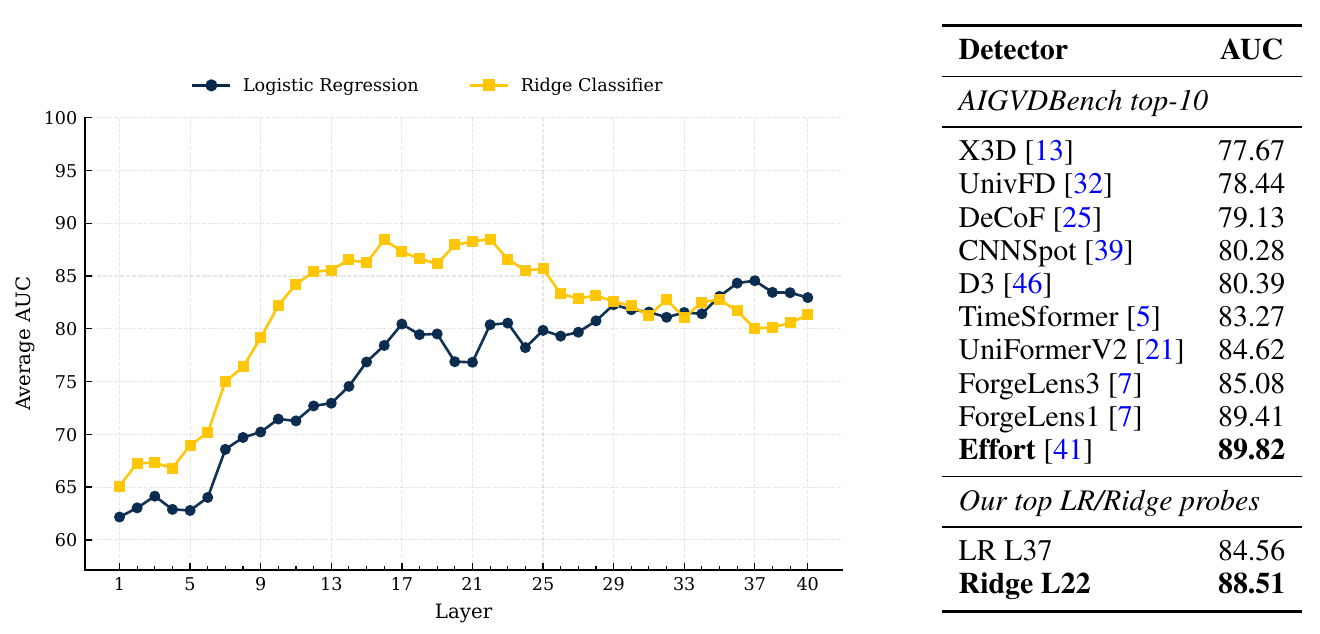
88.51 macro-average per-generator AUC on AIGVDBench for a ridge probe on V-JEPA2 layer 22, Figure 1 and Section 4.1.1.
AUC is reported on a 0-100 scale, not as classification accuracy. The figure places this beside the benchmark’s reported detector scores, including 89.82 for Effort; those baseline scores are reported comparisons, not new reruns.
Scope
This is a preprint. Representation geometry is diagnostic, not a causal explanation of detection or evidence of deployment reliability. The MLAAD audio target set is spoof-only, so its metric is spoof recall, not full real-versus-fake accuracy.
Source
Bibliographic reference
Samuel Pagon, Yixuan Shen, Vishal Asnani, Feng Liu. (2026). What Do Deepfake Benchmarks Measure? An Audit Using Frozen Self-Supervised Representations. arXiv:2606.26384.