
Research / 2025
CustomMark: Customization of Diffusion Models for Proactive Attribution
Published in IEEE/CVF International Conference on Computer Vision, APAI Workshop (ICCV Workshop), 2025
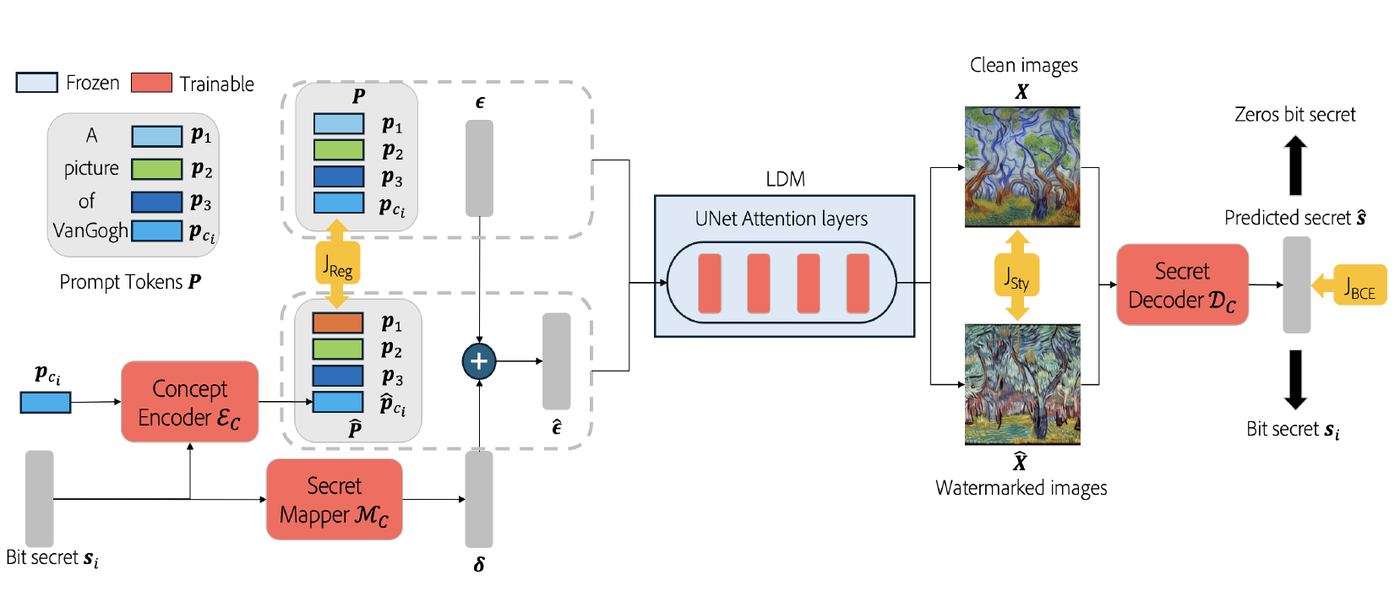
Overview
Can attribution be added to a pretrained generator without retraining the full model? CustomMark selectively customizes concepts so that generated images carry identifiers for relevant objects, styles, or other concepts.
How it works
- A concept encoder and secret mapper perturb a concept’s token embedding and the input noise using its bit secret.
- Training fine-tunes the diffusion model’s attention weights; the model is not entirely fixed.
- Style-preservation and decoding objectives balance recognizable concepts with recoverable attribution.
New concepts can be introduced sequentially. Textual inversion extends the approach to concepts not already represented by suitable tokens.
A reported result
89.25% attribution accuracy on WikiArt, versus 87.19% for ProMark, in the conditional-generation comparison in Table 1.
This is concept-attribution accuracy, not per-bit recovery. The same table gives broadly comparable ImageNet results, so the WikiArt comparison should not be generalized into a universal advantage.
Scope
CustomMark requires a customized generation pipeline and concept-specific signals. It does not retroactively prove the training-data membership of an arbitrary unwatermarked image.
Source
Bibliographic reference
Vishal Asnani, John Collomosse, Xiaoming Liu, Shruti Agarwal. (2025). CustomMark: Customization of Diffusion Models for Proactive Attribution.